The City Beyond · AI time-travel game
The City Beyond: an open-ended time-travel game.
Use knowledge from the future to invent objects and persuade characters. Describe your idea; the game decides whether it works and what changes.
Solo project. I designed the game and its AI systems, wrote the evaluation cases, and built the prototype with Claude Code and Codex as my coding agents.
- Problem
- Most games give you a menu of choices. I wanted players to solve problems by explaining ideas in their own words, and the game to judge those ideas fairly.
- What I built
- A Godot game with a Python backend. A model judges each typed invention or action, game code checks the materials and saves the result, and characters react from their own memory and knowledge.
- Stack
- Godot 4, Python, SQLite, OpenAI models for judging, characters and image generation, replayable evaluation suites
- Results so far
- 13/13 initial invention cases passed, including attempts to override the rules
- Typed intents understood correctly in 180/189 eval runs, at a 0.29s median
- Text costs of $0.02–0.07 per play session
- 601 logged attempts reviewed to find silent failures, now covered by effect checks and 500+ automated tests
Not yet playtested with unfamiliar players.
The City Beyond: inventing a compass
A recorded invention attempt, heading test and entry into the city.
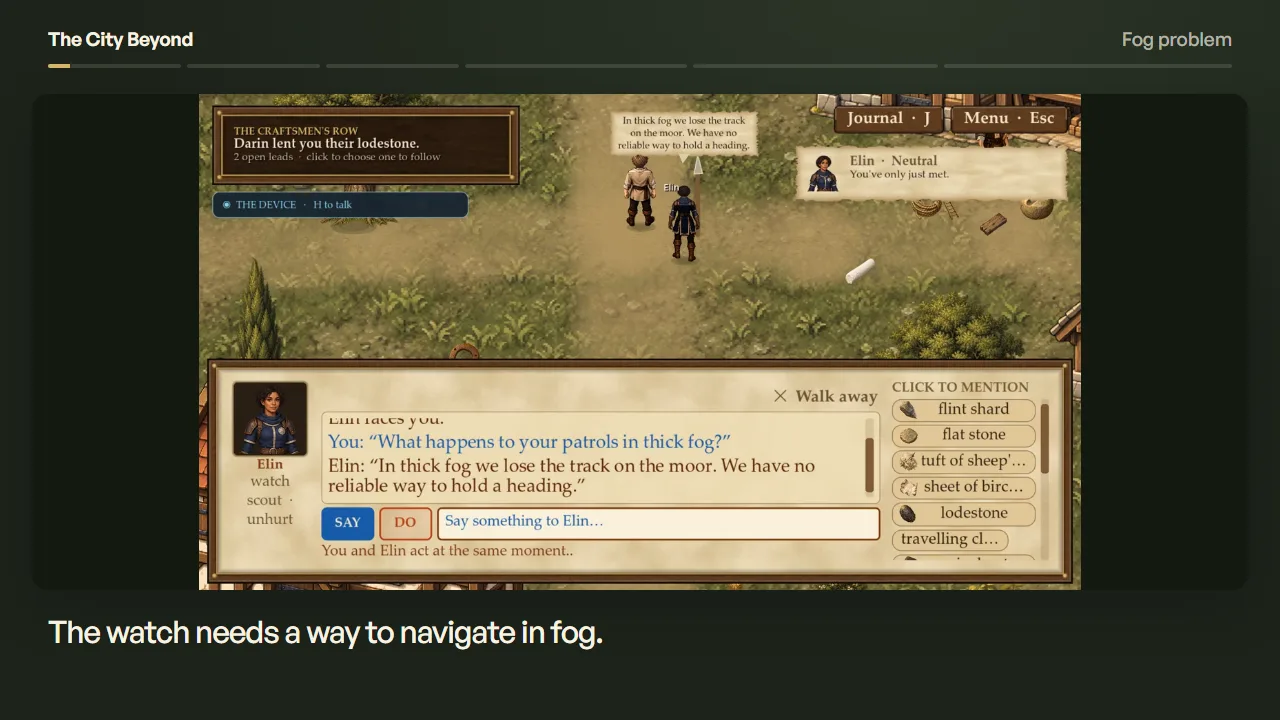
An idea I wanted to build since 2022.
When I first heard about ChatGPT in 2022, I imagined a game where players could solve problems using knowledge from the future. They would explain their ideas instead of choosing from predetermined dialogue options.
I began development in September 2026, when I felt the models were capable enough and I had time to pursue it. The first playable prototype took roughly two weeks. Its initial objective is to enter a guarded city through an invention, persuasion or another approach.
Could the game judge an invention?
Before building more of the game, I needed to check whether it could judge an invention the player described. I moved that test ahead of infrastructure work. The player had to be able to propose a method, understand the response and receive an object when it worked.
The compass recording shows the distinction: rubbing bronze with a lodestone fails; using iron works. The player then assembles a floating needle. AI proposes the outcome, while game code checks the materials and saves the object. All 13 initial test cases I wrote passed, including impossible inventions and attempts to override the rules.
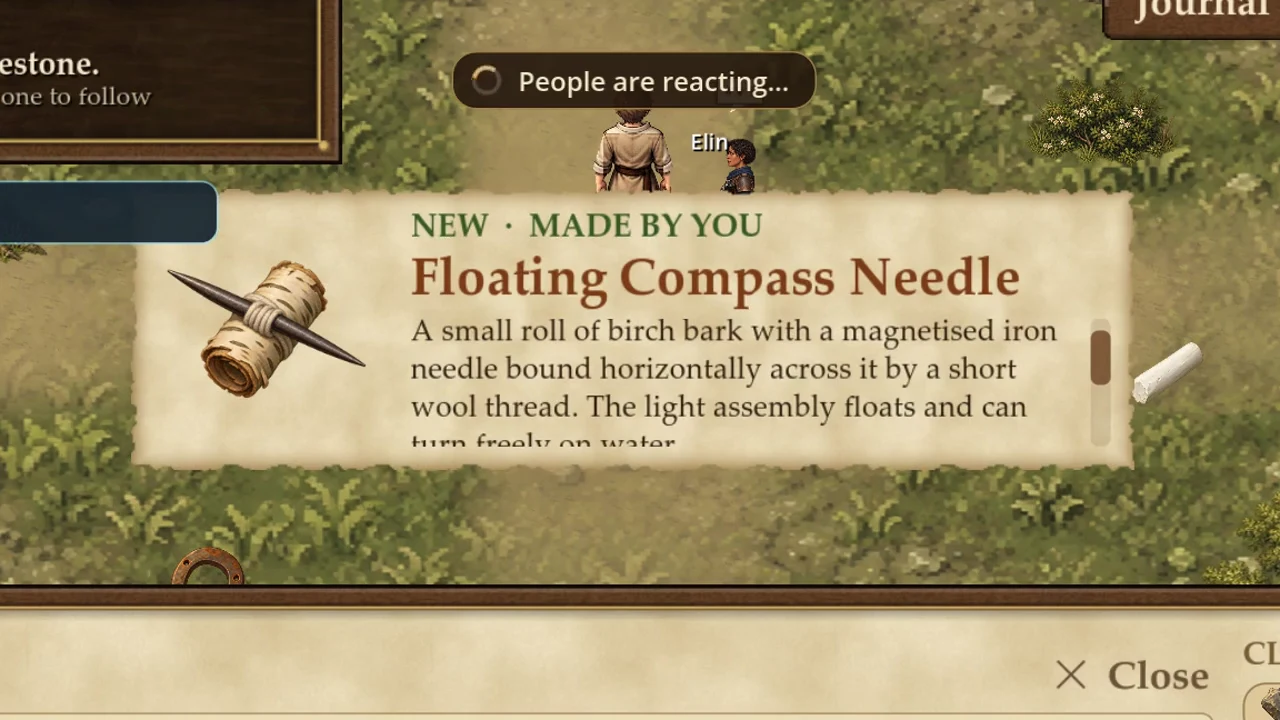
The game said it worked. Nothing changed.
Some accepted actions changed only the narration. The game could say a permission slip had been written without creating anything the player could use. I added reusable effects for objects, permissions and relationships, then made accepted actions update the saved game.
I found these gaps in a review of 601 logged attempts. After the changes, 27 of the 28 effect checks I wrote passed. One still failed.
In the compass recording, the captain asks for a heading test. Demonstrating the compass earns permission to enter. The player can then walk through the gate.
Their 601 attempts showed it: chalk writing a permission slip on bark, … water over Bren and a kiss for Hessa were all “done” and changed nothing; a kiss was seen by nobody.
The logs contradicted my first diagnosis.
Across four of my play sessions, characters made five arrests and started three chases. I blamed the specialist service that chose their actions. The logs contradicted that explanation: the service had run out of credit, and all 133 decisions came from the fallback model.
The problem was in the choices I gave the characters, including an aggressive “seize” action. Switching providers would leave that choice available. I retired the separate decision service and used one model for each character’s actions and conversation, with access to that character’s knowledge.
All 133 decisions in those games came from the fallback model. The real cause was the design: a menu of moves with “seize” on it.
What works, and what I still need to test.
The prototype judges inventions, saves their effects and lets characters respond to what they know. In the recorded compass route, the invention earns permission to enter the city. The player walks through the gate, where the current playable area ends.
The prototype includes training levels, combat and quests. I built these before testing with unfamiliar players. I still need to see whether people enjoy describing ideas, understand why an attempt fails and can find a route into the city without hints.
Evaluation methods and technical detail
Historical measurements from 27–30 September, with decision timings updated 7 October 2026: invention judgment p95 7.7s (target ≤12s); character decision p95 0.6s (≤1.5s); first reply p95 6.3s (≤3s, missed). Text costs were $0.02–0.07 per session, excluding generated images.
The current decider, added on 7 October on OpenAI’s Decisions API, matched 180/189 authored intent judgments with a 0.29s median, versus 1.7s on the Responses API route. Its first run scored worse (162/189) because it had been given the characters’ brief; a brief of its own fixed that. It is separate from the specialist service retired on 29 September. A change to bystander checks reduced unwanted interruptions from eight to zero across 57 controlled rounds, while useful interjections fell from 5/9 to 4/9.
The proposed five-player test asks whether at least three enter the city, future knowledge is used in two different ways, and median “The game understood what I was trying to do” reaches 4/5. These are targets. View evaluation sources ↗
Full project promo
2:14 · With soundThe City Beyond · Full promo · 2:14 · Recorded gameplay
Source code, development decisions and evaluation files are in the public repository.