SimReview · Paramedic interview practice
SimReview: feedback for paramedic interview practice.
Record a practice interview with a helper playing the patient. Replay the exchange behind the AI feedback, then choose a focus for another attempt.
Solo project. I designed the product, the AI review pipeline and its evaluations, and built the app with Codex as my coding agent.
- Problem
- Paramedic students practise patient interviews with a peer, but nobody reviews the recording, so missed follow-up questions go unnoticed.
- What I built
- A phone-first web app that turns a practice recording into a speaker-separated transcript, rubric feedback linked to the exact moment in the recording, and one focus for the next attempt. Works in English and Hebrew.
- Stack
- Python, FastAPI, React, TypeScript, Postgres (Neon), Vercel and a Render worker, OpenAI transcription and LLM grading, FFmpeg
- Results so far
- Grader agreement went from 24/40 to 40/40 on a frozen benchmark, and 8/8 on held-out cases
- A case check blocked 8/8 wrong or unverifiable recordings before grading
- 130+ backend and 50+ browser tests
Tested on synthetic examples so far. Not yet evaluated with students or instructors.
SimReview: practice and feedback
A recorded example of the interview, review and next-practice selection.
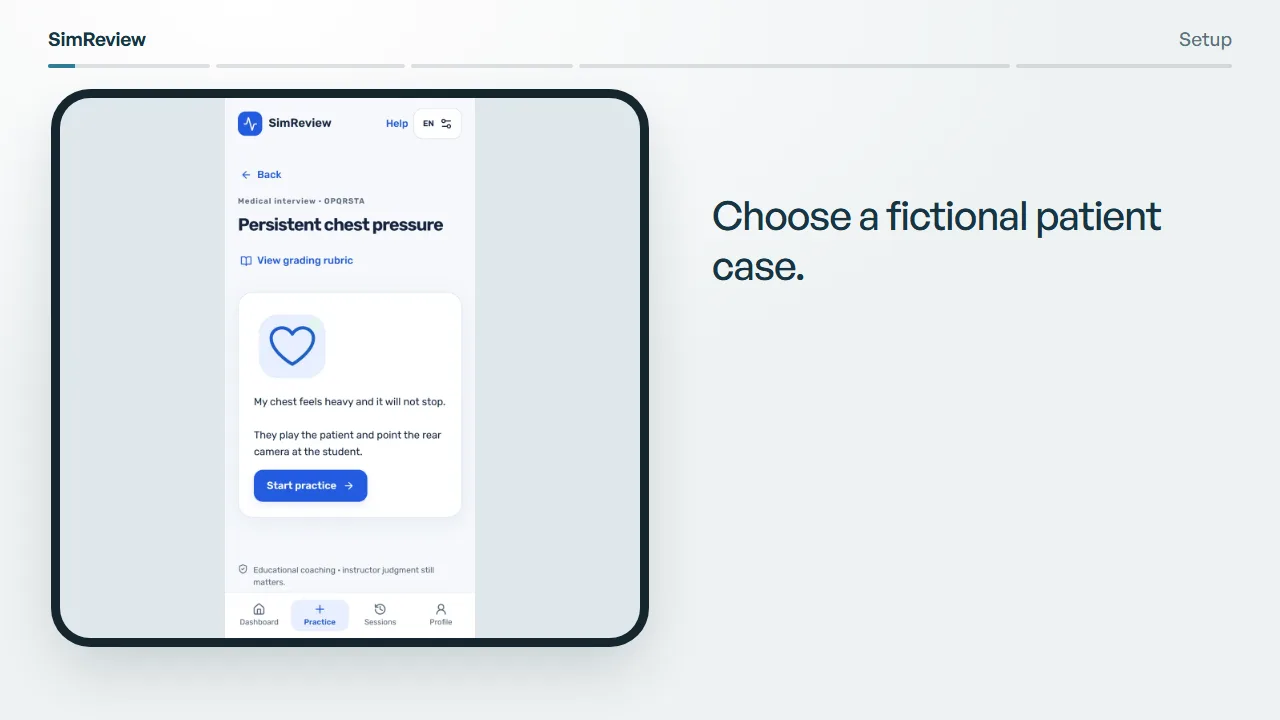
Reviewing practice between training sessions.
I built SimReview to help paramedic students review their practice interviews between training sessions. A student can remember every question on the checklist and still miss part of the patient’s answer. I wanted the review to point to those moments in the recording.
The helper reads a fictional patient guide on the recording phone. The app reviews the audio or video afterwards and returns a transcript, a score against the interview criteria and coaching in English or Hebrew.
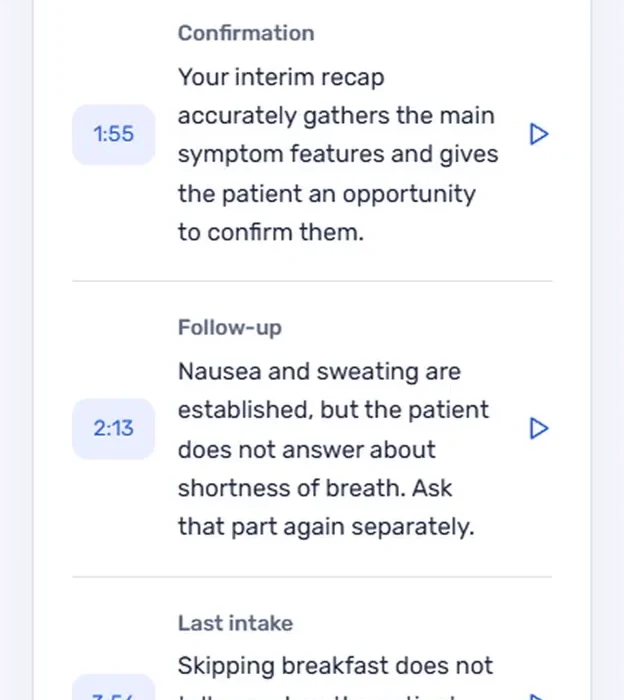
One question, three symptoms, two answers.
I added replay links so a student could check the feedback against what was actually said. A score alone could not explain a missed follow-up.
At 2:13 in the English example, the student asks about nausea, sweating and shortness of breath together. The patient mentions nausea and sweating. The breathing question goes unanswered. Selecting that feedback plays the exchange; the coaching recommends asking about breathing separately.
I expanded the review to cover follow-ups and summaries as well as initial questions.
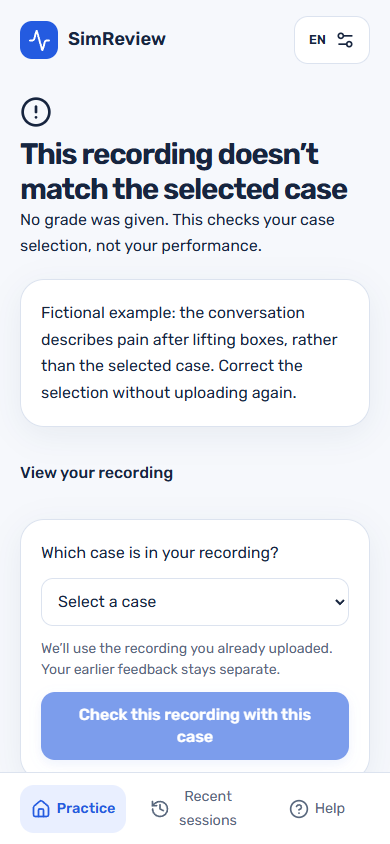
The wrong case received a plausible score.
During testing, SimReview graded a recording against the wrong patient case and returned a plausible assessment. I added a case check before grading. If the recording contradicts the selected case, the review pauses and the student can correct the selection without recording again.
I kept case matching separate from interview completeness. Missing a question should affect the review, not automatically reject the recording. The app pauses when it finds a contradiction or too little patient speech to identify the case.
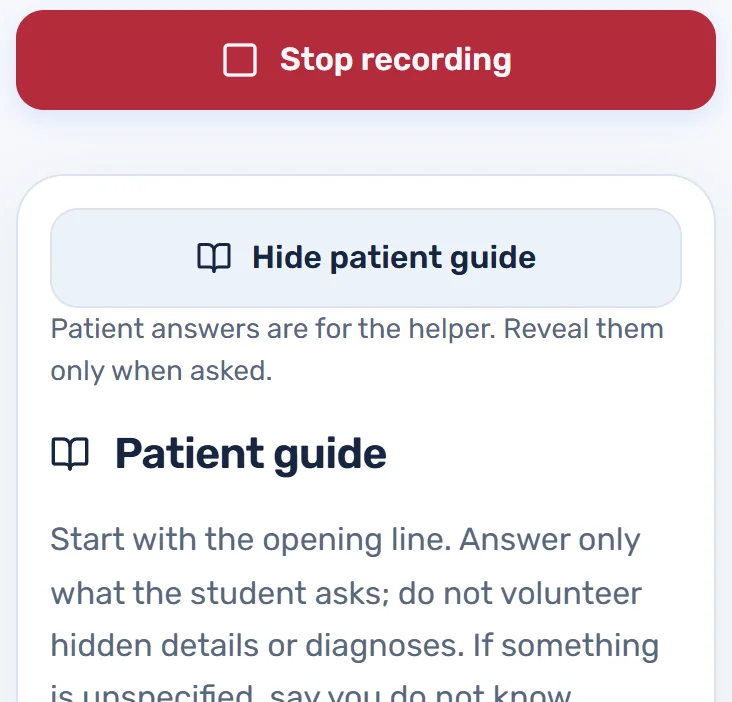
Keep the patient guide usable while recording.
The helper needs the patient guide during the interview. I gave it its own scrolling area and kept the recording controls visible, so the practice can run on one phone. Audio is the default; students can also record video.
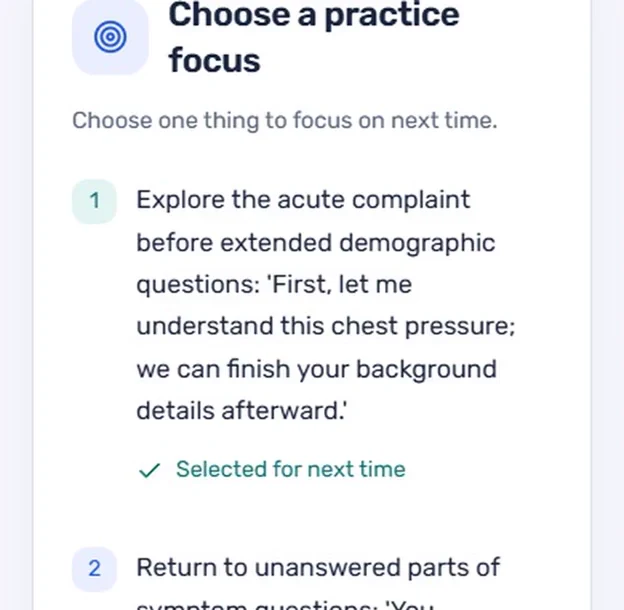
After reviewing an attempt, the student can save one focus for the next practice. Here, the student selects exploring the main complaint before asking extended demographic questions.
What the tests show so far.
The prototype records practice interviews, links feedback to the original exchange and saves a focus for another attempt. It includes 12 labeled, AI-voiced examples visitors can review.
In tests on the 12 example interviews, ten scores fell within the ranges I expected and both wrong-case recordings were caught. In a separate test of 24 transcripts, all eight wrong or unverifiable cases were blocked before grading. I wrote the examples and expected results. These checks do not measure learning improvement.
Next, I would ask instructors to review the feedback and observe whether students use their selected focus in another attempt.
Evaluation methods and technical detail
Two separate evaluations
The 12-interview calibration used six scripted, AI-voiced audio interviews per language, run through the production pipeline. Scores followed the intended order in both languages. Ten landed in their target bands on the first attempt; the two misses exposed dropped one-word Hebrew answers and a miscalibrated script. Both wrong-case recordings were caught.
The separate frozen transcript benchmark used 16 development fixtures and eight reserved examples. Agreement with authored rubric labels moved from 24/40 to 40/40 on development cases; reserved agreement was 8/8. The saved-output replay covers 230/230 meaningful turns, with two layout omissions among 240 inventory events. Later caption changes did not receive a fresh holdout; total scores varied across model runs.
Recording and scoring
Audio excludes recording-limited categories by default, leaving 74 eligible points. Observable video body language can add a four-point item. Other unassessable items can reduce the available points. The student score is normalized, so 97/100 in the synthetic capture does not mean 97 raw rubric points.
Video body-language ratings are enabled in the prototype but have not been validated against independent human ratings. Unclear footage is excluded with a framing tip. The 24 clinical cases remain research drafts awaiting instructor approval.
Full project promo
1:40 · With soundSimReview · Full promo · 1:40 · AI-voiced example interviews; real app footage
The app includes a read-only account with labeled example interviews. Email me for a walkthrough ↗